
Atharva
Back to work

Sentinel AI · Enterprise surveillance · Desktop

One security question.
One connected answer.

A conversational assistant inside SecureWatch, so security staff can ask in plain language instead of piecing records together across modules.

Placeholder · Sentinel AI in SecureWatch
Role
UX Designer
Team
2 AI/ML · 1 full-stack · 1 PM
Timeline
1 month · April 2026
Product
SecureWatch

Problem

One question about a person or vehicle meant checking several modules and connecting the records by hand.

Solution

A workspace to ask by text or voice and get one structured answer, scoped to the user’s permissions.

Impact

2 min → 10 s to find an incident summary

Problem

The records existed. The answer took work.

SecureWatch holds person detection, vehicles, violations, zone restrictions and reports. Related records sat in separate views, so the user had to carry the connections.

Before

One question

Person logsVehicle logsZone & incident records

The user pieces it together

With Sentinel AI

One question

Sentinel AI retrieves linked records

One structured answer

The user reviews and decides

Illustrative model of the workflow, not a production architecture.
  • Review a person’s history

    Person and vehicle logs needed separate checks.

  • Verify restricted access

    Identity, clearance and incidents meant different lookups.

  • Connect recurring events

    Events across dates and modules had no unified history.

Design challengeHow might we help authorized users find connected information, without handing judgment to AI?

Users

Three roles. Three kinds of question.

RoleContextWhat they needed
System AdminManages users, permissions and linked records, mostly at a deskPrecise text queries and linked information
Security Guard ManagerEntry and incident work, with varied system familiarity and language comfortQuick context, voice entry and helpful clarification
Super AdminWidest authority, less frequent system useA scoped overview without long navigation

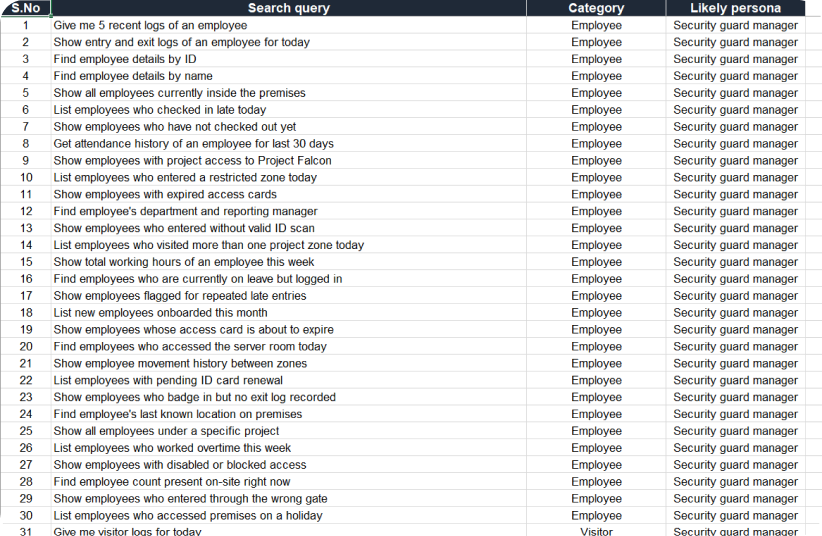
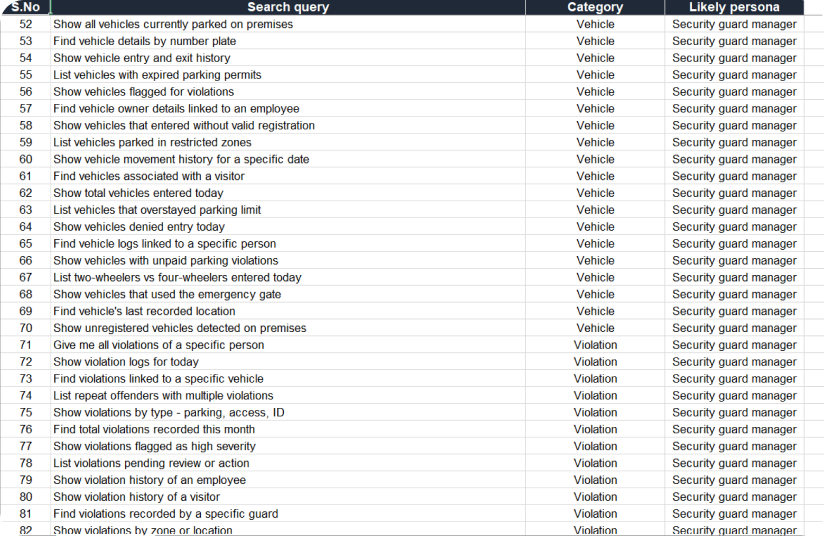
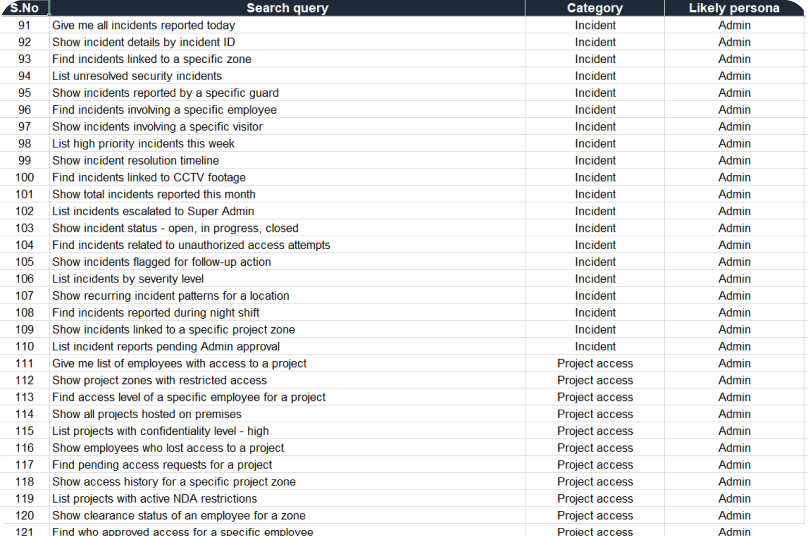
What people searched for

  • Recent logs
  • Violation details
  • Linked vehicles
  • Zone restrictions
  • Activity status
  • Sensors
  • Permissions

What that meant for the design

  • Organize around linked retrieval
  • Bound every answer by authorization
  • Support both typed and voice queries
  • Clarify natural phrasing, don’t demand commands

Ideation

Three ways to connect the records.

We explored a shared dashboard, advanced filters and an AI chatbot. The deciding question was how easily staff could follow up when they didn’t know which records they needed.

Unified dashboard

What we considered
Put frequently cross-referenced modules, such as Person Logs and Vehicle Logs, into one view.
Trade-off
It puts common records side by side, but the team has to decide in advance which ones to combine.

Staff would still piece together unfamiliar patterns and related records by hand.

Advanced search filters

What we considered
Let staff narrow results by person, date range, zone or violation type.
Trade-off
Filters make precise lookups easier when the criteria are known. Open-ended questions take more steps and require staff to know which fields to use.

Useful for known criteria, with more work for guards investigating an unclear situation.

AI chatbot

What we considered
Let staff ask in plain language, bring linked records into one answer and revisit earlier conversations.
Trade-off
The assistant can misread a question. The design asks for clarification when needed and retrieves only records the user is allowed to see.

Selected. Staff can follow up in the same thread without knowing which module holds the answer.

How a question becomes an answer
  1. AskBy text or voice
  2. InterpretIntent and entities
  3. RetrieveWithin the user’s permissions
  4. AnswerStructured context, no data, or a clarifying question
  5. DecideA person reviews and acts

Key decisions

Four decisions that shaped the product.

01

Start with the question

A dedicated workspace inside SecureWatch: direct input, frequent queries and structured results in one thread, with the rest of the system still within reach.

Trade-offA consolidated answer is only as useful as the retrieval behind it.

Placeholder · Sentinel AI workspace
02

Inform the decision, don’t make it

Answers stay within the user’s permissions. Restricted, empty and unclear results each explain themselves, and responsible staff make the operational call.

Trade-offA constrained assistant feels less seamless. In security work, clear limits matter more.

Placeholder · Authorized response
Placeholder · Restricted, no data, clarification
03

Design for work away from the desk

Text suits names and IDs. Voice helps when hands are busy, and English, Hindi and Marathi were considered for voice queries.

Trade-offNames, IDs and noise create ambiguity, so the design shows what was understood and asks before answering.

Placeholder · Text and voice input
Placeholder · English, Hindi and Marathi queries
04

Design what the system can understand

With two AI/ML engineers and a full-stack engineer, I mapped real search language to intent, available data and response structure, then designed the states between asking and answering.

My partI translated security tasks into interaction states. Engineering owned the AI and data capabilities.

Placeholder · Query, processing, structured answer

Final design

A calmer place to ask and review.

The question and its context stay together, from the first prompt to the final review.

Placeholder · Complete desktop workspace
Placeholder · Frequent searches
Start fast. Frequent searches as a starting point.
Placeholder · History and new chat
Pick up again. Past conversations and a fresh start.

Outcome

Faster answers, with judgment left to people.

  • 2 min → 10 sTime to find an incident summary
  • 80%Faster searches
  • 32%Increased usage

What I learned

Search language, retrieved data, permissions and interface clarity together decide whether an AI answer can be used responsibly. Design for the moment the system is unsure.

What I’d measure next

  • Task completion and answer clarity
  • Denied and ambiguous requests
  • Whether people understand the assistant’s limits